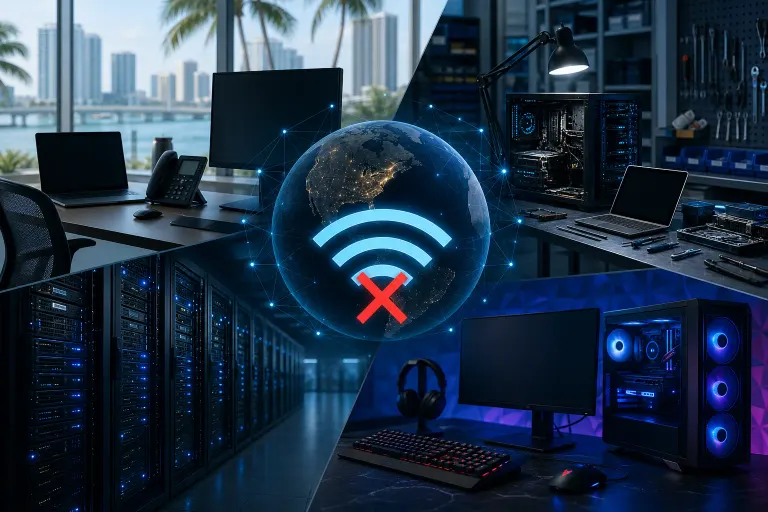
What South Florida Small Businesses Lose When Internet Goes Down
TL;DR: Internet outages hit small businesses harder than most owners expect. Lost sales, frozen operations, and damaged client trust pile up fast. The good news is that most of the damage is preventable with the right setup in place.
What Happened
Florida businesses, especially smaller operations along the Palm Beach and Treasure Coast corridors, deal with internet disruptions more often than the national average. Hurricanes, tropical storms, construction accidents cutting buried fiber, and the routine failures of aging ISP infrastructure all contribute.
But you don't need a named storm to lose connectivity. A router that overheats (which happens faster in South Florida humidity), a misconfigured modem after an ISP firmware push, or a failed switch can pull your office offline just as completely as a Category 1 hurricane. The cause doesn't matter much when customers are waiting.
Recent years have seen significant outages tied to both weather events and infrastructure failures across Palm Beach County. Strip malls, medical offices, retail shops, and service businesses all went dark for hours or, in some cases, days. Most had no fallback plan.
Why It Matters
Let's be specific about what actually stops working when the internet goes down.
1. Point-of-Sale Systems
Most modern POS systems require an internet connection to process card payments. If you're running a cloud-based register, Square, Toast, Clover, or similar, an outage means cash only. Many customers don't carry cash. Some will leave. Some won't come back.
A two-hour outage during a lunch rush at a restaurant, or a Saturday afternoon at a retail shop, can represent a significant chunk of the day's revenue. Gone.
2. VoIP Phone Systems
If your business phones run over the internet, and most small business phone systems do now, your phones go down with your connection. Customers get a busy signal or silence. Calls go unanswered. Leads evaporate.
This one is particularly painful because customers often interpret an unanswered phone as a business being closed or unreliable, not as a temporary technical problem.
3. Cloud Software and File Access
If your team uses Microsoft 365, Google Workspace, QuickBooks Online, or any other cloud-based tool, those applications stop functioning offline. Work halts. Your team sits idle or scrambles to figure out what they can actually do without a connection.
Some applications have limited offline modes. Most don't have enough for a full workday. This is especially disruptive for businesses with remote staff or multiple locations.
4. Email and Client Communication
This one gets underestimated. You can't respond to inquiries, send quotes, follow up on proposals, or coordinate with vendors. If you're mid-project with a client, radio silence from your end raises concern fast.
Customers and partners don't know you're experiencing a technical issue. They just know you aren't responding.
5. Security Systems and Remote Access
Cloud-managed cameras, alarm monitoring, and access control systems often depend on internet connectivity. An outage can leave gaps in your physical security or lock your remote management tools out completely.
If you have staff working remotely, they lose access to shared drives, internal tools, and anything behind your network. That's not just inconvenient, it's a potential data exposure risk if people start improvising with personal accounts and personal devices.
6. Reputation and Client Trust
This one doesn't show up in an hourly revenue estimate, but it compounds over time. A client who couldn't reach you during an outage may not complain. They may just find someone else next time.
Small businesses survive on repeat business and word of mouth. A pattern of being unreachable, even temporarily, erodes trust faster than most owners realize.
Tired of IT that breaks at the worst time? Talk to our business IT team

What We Don't Know Yet
A few things remain genuinely uncertain, and it's worth being honest about them.
First, the actual cost per hour of downtime varies enormously by business type, time of day, and how much of the operation depends on cloud tools versus local systems. Published averages from industry reports vary widely and often reflect enterprise environments rather than small businesses. Treat any specific number you read with skepticism.
Second, ISP reliability in Palm Beach County has been improving, but the infrastructure in some commercial areas is aging. It's unclear how quickly fiber buildout will reach smaller strip mall corridors in cities like Lake Worth, Boynton Beach, or Port St. Lucie. If you're in one of those areas, your risk profile may be higher than average.
Third, the effect of AI-based customer expectations is still developing. Customers are increasingly impatient with delays. Whether an outage that might have been forgiven five years ago now causes permanent churn is an open question, but the trend is not favorable for businesses that go dark unexpectedly.
What to Do About It
Most of this is preventable. That's the part that should stick with you. Here's a structured approach.
1. Add a secondary internet connection.
A cellular backup connection, sometimes called LTE failover, keeps your most critical systems online when your primary ISP goes down. The cost is modest compared to a single day of lost revenue for most businesses. This is the single highest-leverage change most small offices can make.
This is something we configure regularly for clients through our business networking services. A properly set up failover connection switches automatically, often before staff even notice the primary line dropped.
2. Know what's actually cloud-dependent.
Do a quick audit. List every piece of software your team uses daily and check whether it has an offline mode. Identify your POS, your phones, your file storage. That list tells you exactly what goes down and in what order. Most business owners haven't done this exercise and are surprised by how much is internet-dependent.
3. Have a manual fallback for payments.
Keep a written or printed price list. Know how to accept cash. If your POS provider offers an offline mode, test it before you need it. Some systems will queue transactions and process them when connectivity returns. Know whether yours does.
4. Communicate proactively during outages.
If you have a scheduled maintenance window or know a storm is coming, notify clients ahead of time. Even a simple text or email saying you may be unreachable for a few hours sets expectations and prevents the silent erosion of trust.
5. Consider managed IT coverage.
If you're running a multi-person operation, having someone monitor your network and respond to failures is worth serious consideration. Managed IT means someone is watching your infrastructure continuously, not just when something breaks loudly enough for you to notice.
6. Review your backup and recovery posture.
An outage is also a good moment to ask whether your critical data is protected. If your internet goes down and someone needs a file that only exists in a cloud drive you can't reach, that's a problem. A proper backup and disaster recovery plan ensures your data is accessible even when primary systems fail.
7. Get your physical hardware in good shape.
A lot of outages that look like ISP problems are actually hardware problems. A failing router, an overheating switch, or a flaky cable inside the wall can mimic a provider outage perfectly. South Florida heat and humidity accelerate hardware degradation faster than most business owners account for. If your networking gear is more than four or five years old, it may be living on borrowed time.
If you're not sure where to start, reach out to us. We can assess your current setup and give you a straight answer about where your vulnerabilities are without a hard sell attached.
Internet outages are not a matter of if for South Florida small businesses. They are a matter of when and how long. The businesses that come through them without significant damage are the ones that planned ahead. It's not complicated. It just requires treating the network as the critical infrastructure it actually is, not an afterthought managed by whoever set it up years ago.
Tired of IT that breaks at the worst time?
We run managed IT, backups, and security for South Florida businesses so you can stop thinking about it.