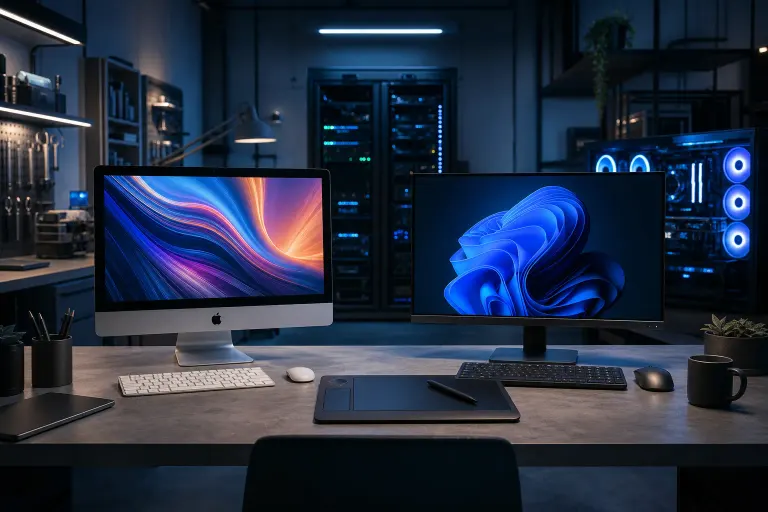
Mac vs Windows for Graphic Designers: A Practical Comparison
TL;DR: Both platforms run Adobe Creative Cloud, Affinity, and most professional design tools. Mac wins on display calibration and build consistency; Windows wins on hardware flexibility and price-to-performance. The right pick depends on your budget, upgrade plans, and whether you need tight mobile device integration.
At a Glance
| Factor | Mac (Apple Silicon) | Windows PC |
|---|---|---|
| Display quality out of box | Excellent, factory-calibrated | Varies by monitor/panel choice |
| Software compatibility | All major design apps supported | All major design apps supported |
| Hardware upgrade path | Sealed, limited | Open, modular |
| Price for comparable specs | Higher | Lower to equivalent |
| GPU options | Integrated (M-series unified memory) | Discrete GPU options (e.g., RTX series) |
| OS stability | Very consistent | Can vary; driver management needed |
| iOS/iPadOS workflow | Native Sidecar, Handoff | Third-party workarounds |
| Repairability | Difficult, Apple-dependent | Generally easier |
Display and Color Accuracy
For print and brand work, color accuracy is not optional. Apple's Pro Display XDR and the built-in Liquid Retina displays on MacBook Pros ship with factory calibration and wide color gamuts (P3). That matters when a client's logo color has to match across screen and print.
Windows doesn't mean bad color. Pairing a Windows machine with a calibrated IPS or OLED monitor, plus a hardware colorimeter like the X-Rite i1Display, gets you to professional accuracy. The difference is that Mac keeps it simple out of the box, while Windows requires deliberate monitor selection and calibration effort.
If you're working in a studio where monitors are already calibrated, this gap narrows significantly.
Software Compatibility
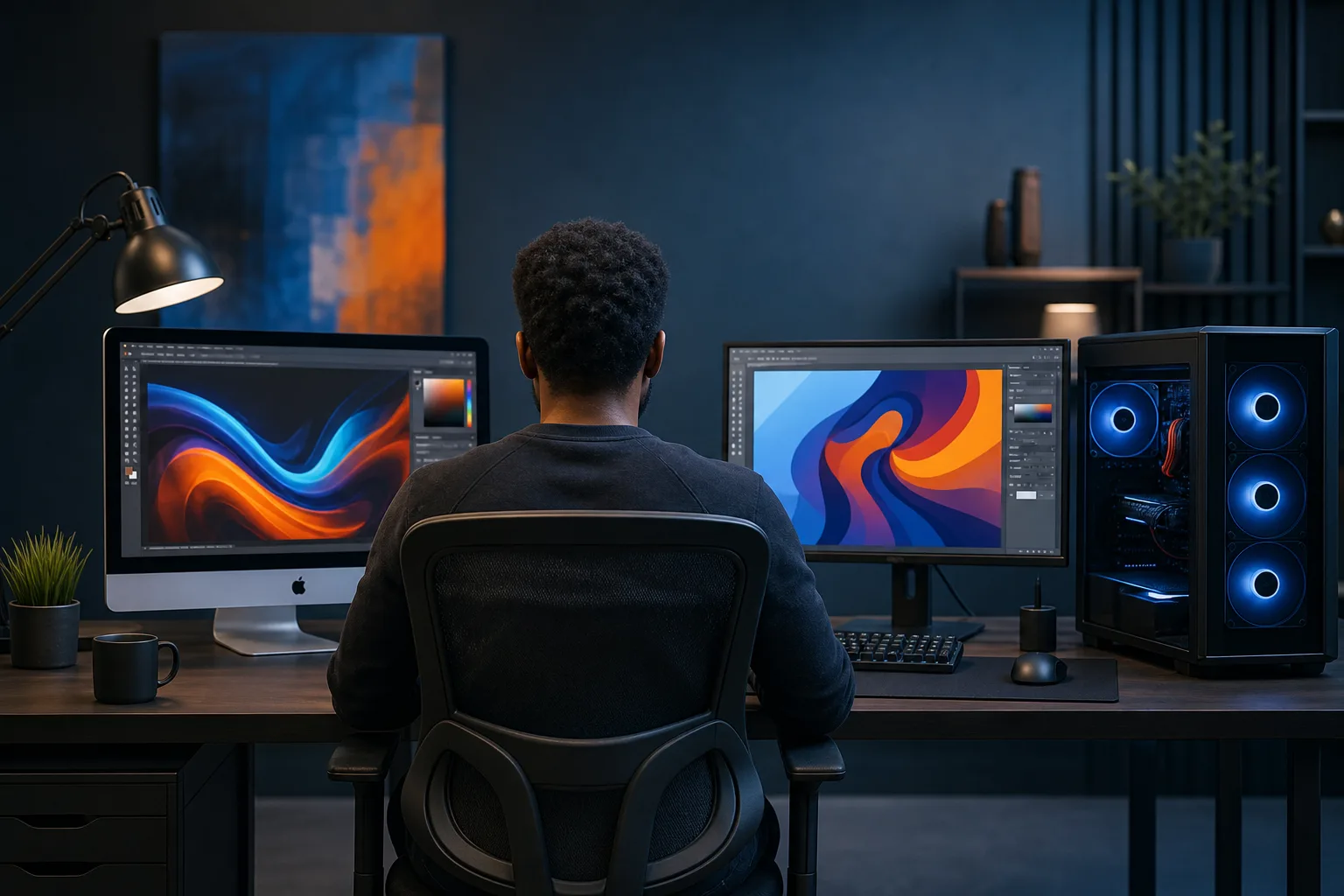
Adobe Creative Cloud runs on both platforms. Affinity Designer, Publisher, and Photo run on both. Figma is browser-based. Sketch is Mac-only, which matters if your team uses it. Most other niche tools, like Vectornator (now Linearity Curve) or Procreate, are Apple ecosystem only.
Windows-only gaps are rare in the design world. The bigger software consideration is ecosystem lock-in. If your studio is Mac-heavy, staying on Mac means fewer compatibility friction points with shared assets, font management tools, and project files.
For 3D design work or motion graphics that leans into GPU rendering, Windows machines with discrete Nvidia cards (RTX 4000 series) still outperform Apple Silicon in GPU-intensive tasks like heavy Blender renders, though the M3 Max and M4 Pro chips have closed that gap substantially for lighter workloads.
Hardware Value and Upgrade Path
This is where Windows pulls ahead clearly. A mid-range Windows workstation can be configured with more RAM, a faster discrete GPU, and expandable storage at a lower cost than a comparable Mac. And if your workload grows, you can swap in a new GPU or add RAM without buying a whole new machine.
Apple Silicon Macs use unified memory soldered to the chip. That memory is faster than traditional RAM for the tasks the M-series architecture handles well, but you cannot upgrade it after purchase. Buy the RAM you think you will need for the next three to four years, or you're buying a new machine.
For a designer doing mostly vector work, web UI, and print layouts, a base M3 MacBook Pro with 16GB unified memory handles the workload comfortably. For a designer doing heavy video compositing or 3D rendering, a Windows workstation with 64GB DDR5 and an RTX 4080 may deliver more throughput per dollar.
Computer acting up? Get a real diagnosis. Book a free diagnostic
Stability and Maintenance
Mac's tighter hardware-software integration means fewer driver issues and more predictable OS updates. That consistency is genuinely valuable when you're on a client deadline.
Windows machines require more active maintenance: driver updates, occasional conflicts after major Windows updates, and more varied behavior across different hardware configurations. That said, a well-maintained Windows workstation is rock-solid. The maintenance burden is real, but manageable, especially if you have IT support.
If you're freelancing solo and want the machine to just work, Mac's lower maintenance overhead is a real benefit. If you're in a business environment with managed IT, Windows is more flexible to administer at scale. Fix My PC Store handles both platforms for business IT clients across West Palm Beach and South Florida.
Repairability and Total Cost of Ownership
Apple Silicon Macs are notoriously difficult to repair. The soldered RAM and SSD, proprietary screws, and Apple's parts pairing system mean that out-of-warranty repairs can be expensive. A liquid spill on a MacBook Pro is often a logic board replacement.
Windows laptops and desktops are generally more repairable. Components are more accessible, and parts are widely available. If you're near West Palm Beach and something goes wrong with either platform, Mac repair and laptop repair are both available at Fix My PC Store on Okeechobee Boulevard.
Over a five-year period, factor in the cost of potential repairs and whether you will need to buy a higher-spec Mac upfront versus upgrading a Windows machine incrementally.
Ecosystem and Workflow Integration
If you use an iPhone and iPad in your workflow, Apple's integration is a real productivity advantage. Sidecar turns an iPad into a second display or drawing tablet. Handoff lets you start a document on your phone and pick it up on your Mac. AirDrop moves files instantly.
None of this is impossible on Windows, but it requires third-party apps and extra setup steps. If the iPad with Apple Pencil is central to your illustration or mockup workflow, the Mac ecosystem removes friction that genuinely adds up over a workday.
Verdict
Choose Mac if: You want consistent color accuracy without extra setup, you're already in the Apple ecosystem, you prefer lower maintenance overhead, or Sketch is a requirement. The M-series chips handle most design workloads confidently.
Choose Windows if: You want to maximize RAM and GPU specs per dollar, you need upgrade flexibility over time, your work involves heavy 3D rendering or GPU compute, or your studio already runs a managed Windows environment.
Neither platform is objectively better for all designers. The gap in software support has essentially closed. The remaining differences are hardware economics, ecosystem integration, and how much you want to self-manage versus just open the lid and work.
If you're setting up a design workstation in South Florida and want a second opinion on specs or platform fit, stop by Fix My PC Store at 10140 Okeechobee Blvd, Suite B, West Palm Beach, or get in touch. Initial checks for hardware concerns are free for most standard in-store visits.
Computer acting up? Get a real diagnosis.
Fix My PC Store has repaired thousands of machines across West Palm Beach. Free diagnostics, honest pricing, no upsell games.