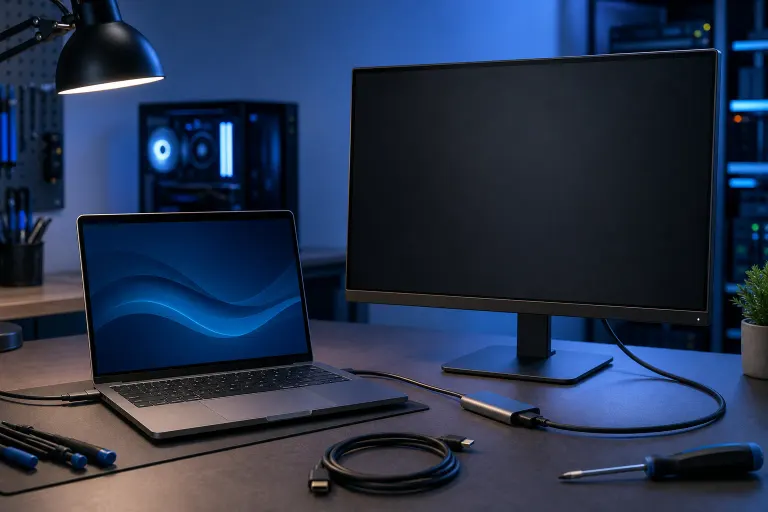
Laptop Won’t Detect an External Monitor? Check These Causes
TL;DR: When a laptop will not detect an external monitor, start with the physical connection: monitor power, correct input, cable, adapter, and laptop port. Then check Windows or macOS display detection, resolution, drivers, docks, and whether the laptop's USB-C port actually carries video. Most failures are ordinary and fixable. The adapter aisle, however, is full of expensive little lies.
What you need
Before you start, gather the laptop, the external monitor, its power cord, the video cable, and any dock or adapter currently involved. If possible, have one known-good cable or another screen available for testing. You do not need to buy a new monitor because one cable had a bad day.
Know what connection you are using:
- HDMI is common on TVs and monitors. It carries video and often audio.
- DisplayPort is common on desktop monitors and business docks.
- USB-C may carry charging, data, video, all three, or just some of them. The shape tells you almost nothing. Lovely design choice, that.
- Thunderbolt 3, 4, and 5 use the USB-C connector shape and have additional capabilities on compatible equipment; older Thunderbolt 1 and 2 ports use Mini DisplayPort.
- VGA and DVI appear on older equipment. They can still work, but adapters may introduce limits or failures.
If the laptop screen itself is damaged or the machine has other display trouble, handle that first. Our laptop repair team can determine whether the problem is a screen, cable, port, graphics hardware, or something less obvious.
1. Confirm the monitor is actually on and using the right input
Start with the monitor, not Windows. A black screen does not necessarily mean the laptop failed to send a signal. It may mean the monitor is asleep, set to the wrong input, or unplugged from power after somebody moved the desk around.
Check that the monitor's power light comes on. Open its built-in input or source menu and select the port you are using, such as HDMI 1, HDMI 2, DisplayPort, or USB-C. If you connected the cable to HDMI 2 but the monitor is waiting on DisplayPort, the laptop can shout all day and nobody is listening.
If the monitor has multiple inputs, disconnect unused video cables temporarily. Some monitors switch inputs poorly or keep selecting a powered-off device. Then power the monitor off, wait 15 seconds, and turn it back on.
Test the monitor with another source if you can. A streaming box, game console, another computer, or another laptop is enough. If the monitor cannot show an image from any source, the monitor or its power supply is the likely culprit.
2. Check the cable, adapter, and ports in the right order
Disconnect and reconnect both ends of the cable firmly. Do not just wiggle it and declare it “probably fine.” A connector can look seated while being barely attached.
Inspect the cable for bent pins, crushed sections, loose ends, or a connector that feels sloppy. HDMI cables often fail after repeated bending behind a desk. DisplayPort connectors can also appear connected while their latch is not properly engaged.
Try these simple swaps one at a time:
- Use another cable of the same type.
- Use a different input on the monitor.
- Use another video output on the laptop or dock.
- Connect the laptop directly to the monitor, bypassing the dock, hub, splitter, KVM switch, or adapter.
- Test the monitor cable with another computer.
If direct connection works but the dock does not, you have narrowed the issue to the dock, its power, its firmware, its cable, or its compatibility. That is progress, even if the dock had other plans.
Be especially suspicious of cheap USB-C adapters and multiport hubs. They may claim 4K support but fail at a particular refresh rate, refuse to work with certain laptops, or overheat under load. Some need external power. Some are simply junk with a nice product photo.
Also check the laptop port for lint, corrosion, or physical damage. South Florida humidity is not kind to electronics, and neither is a bag full of beach sand. Never force a connector into a port. If a USB-C plug only works at a certain angle, stop using it and get the port checked.
3. Make sure the laptop port supports video output
This is the part that catches people who bought a perfectly good adapter for a port that cannot send video. USB-C is a connector shape, not a promise.
Many newer laptops support video through USB-C using DisplayPort Alt Mode or Thunderbolt. Others use USB-C only for charging and data. A USB-C-to-HDMI cable cannot create video capability where none exists. It is not magic. It is copper and optimism.
Check the laptop manufacturer's specifications for the exact model, not just the product family. Look for language such as “DisplayPort over USB-C,” “DP Alt Mode,” “Thunderbolt,” or an explicit external display specification. A lightning-bolt symbol near the port commonly indicates Thunderbolt, but documentation is still the final word.
If the laptop has HDMI, DisplayPort, or Mini DisplayPort, test that direct output first. It is usually more reliable than involving a stack of adapters. If you must use an adapter, use one designed for the direction you need. HDMI-to-DisplayPort is not always interchangeable with DisplayPort-to-HDMI. Active conversion may be required depending on the source and display.
For a Mac, check the exact model's supported external display count. Some Apple Silicon models support fewer native external monitors than users expect. A dock that advertises extra screens may rely on separate DisplayLink technology, which has its own software and limitations. If you have a stubborn Mac display issue, our Mac repair service can sort out the hardware, cable, and compatibility side without guessing.
4. Tell Windows to detect and use the display
A working physical connection can still leave the screen unused if Windows is set to show only the laptop panel.
Press Windows key + P. Choose Extend to use the external monitor as additional workspace, or Duplicate to show the same image on both screens. Avoid assuming the computer will choose correctly. Computers have always needed supervision.
Then go to Settings > System > Display. Under the multiple-display area, select Detect if Windows does not show the monitor. If it appears, click Identify to see which numbered rectangle represents each physical screen.
If the screen is detected but black, check these settings:
- Select the external monitor and make sure it is not disabled.
- Set a sensible resolution, preferably the monitor's recommended resolution.
- Set a standard refresh rate such as 60 Hz as a test. An older adapter or dock may fail at high refresh rates.
- Confirm the display arrangement. The cursor may be moving onto a screen positioned above, below, or off to the side in Windows settings.
- If you are duplicating displays, test Extend instead. Duplicate mode can force a shared resolution or refresh rate that one device does not like.
Press Windows key + Ctrl + Shift + B to reset the graphics driver. The screen may blink and beep. That is normal. If the monitor wakes up afterward, a stalled graphics driver was likely involved.
If you use a work laptop, company policies or remote desktop software can complicate multi-monitor behavior. A properly configured managed IT service arrangement can keep docks, drivers, and standard display setups from becoming a weekly help-desk ritual.
Computer acting up? Get a real diagnosis. Book a free diagnostic
5. Check macOS display settings and supported arrangements
On a Mac, open Apple menu > System Settings > Displays and check whether the external screen appears. If it does not, reconnect the cable or adapter, restart the Mac and display, and consult Apple’s documentation for your macOS version.
If it is present, choose the desired resolution and refresh rate. Use a standard setting first if the display stays dark or flickers. Turn off unusual scaled resolutions temporarily. You can also arrange the screens and choose whether to mirror or extend the desktop.
For a MacBook, connect the charger directly to the Mac while testing if possible. Some docks behave differently when power delivery is insufficient. Also try connecting the monitor directly to the Mac with a known-good cable. That separates a Mac issue from a dock issue quickly.
If the monitor appears only when the lid is open, that may be expected behavior for your model and setup. Closed-display, or clamshell, operation usually requires power and an external keyboard or mouse, and it can vary by model. Check Apple's documentation for your exact Mac rather than trusting a random comment thread written in 2018. Apple's Mac display support documentation is a sensible starting point.
6. Update or reinstall the graphics and dock drivers
A driver problem is more likely when the monitor worked before, stopped after an update, flickers, disconnects randomly, or appears briefly and vanishes.
On Windows, open Device Manager. Check Display adapters, Monitors, and Universal Serial Bus controllers for warning symbols. Right-click the graphics adapter and choose to update the driver, but do not blindly accept whatever Windows finds as the final answer.
Get graphics drivers from the laptop manufacturer's support page first, especially on business laptops and machines with both integrated and dedicated graphics. Laptop makers may customize drivers for their display hardware, power management, and USB-C implementation. If the manufacturer provides an outdated driver and the problem persists, the graphics chip maker's official support site may offer a newer compatible version. Create a restore point before major driver changes.
For docks, download the correct firmware and driver package from the dock maker's official support page. USB graphics docks, including models that use DisplayLink, often need their own software. Do not use generic driver-download websites. Those places are a buffet of unwanted software and questionable advice.
After updating, restart the laptop fully. Then power-cycle the dock and monitor. Shut down, disconnect dock power for 30 seconds, reconnect power, start the monitor, then start the laptop. It feels primitive because it is primitive. It also works more often than it should.
7. Test resolution, refresh rate, and bandwidth limits
A monitor may be detected but display “No Signal,” go black, or flicker because the selected mode exceeds what the cable, adapter, dock, or port can carry.
This commonly happens with high-resolution and high-refresh-rate monitors. A laptop may support a 4K screen directly but not through a particular dock. A dock may support one high-resolution monitor but not two. An older HDMI version may limit refresh rate. A USB-C hub may share available data bandwidth with Ethernet, storage, and other USB devices; its video capabilities can also be limited by the host connection and hub design. Physics remains stubbornly uninterested in marketing copy.
Set the external monitor to a lower resolution and 60 Hz. If it becomes stable, raise settings gradually until you find the limit. Try another connection type if available. DisplayPort is often a better choice for high-refresh computer monitors, while HDMI may be simpler for TVs and basic office displays.
If you run two or more external monitors, disconnect all but one. Get one display stable first. Then add the second display. This reveals whether the issue is total graphics capability, dock bandwidth, or a bad individual connection.
For office setups with several screens, shared docks, conference-room displays, and frequent hot-desking, the long-term fix may be standardized hardware rather than another adapter. Our business networking and IT team can help identify where the setup is failing and keep the wiring from turning into a bowl of electronic spaghetti.
8. Rule out hardware failure before buying replacements
By now, use your test results to identify the likely bad part:
- Monitor fails with every source: monitor, power supply, or selected input is likely at fault.
- A new cable fixes it: old cable was faulty.
- Direct connection works but dock does not: dock, dock power supply, or dock compatibility is the issue.
- One laptop works on the monitor and another does not: the affected laptop's port, driver, settings, or hardware is the issue.
- No external display works from one laptop port: the port or its internal circuitry may be damaged.
- Screen works only after driver resets or restarts: software, firmware, or power-management behavior is likely involved.
Do not keep plugging and unplugging a damaged port. A loose HDMI port or cracked USB-C port can worsen and damage a cable or adapter along the way. If you have tested with known-good equipment and the laptop still cannot output video, it is time for hands-on diagnosis. Bring the laptop, charger, dock, adapter, and monitor cable if practical. The offending part is usually hiding in that pile.
For local help in West Palm Beach, Palm Beach County, or the Treasure Coast, you can schedule a repair with the gear involved. A technician can test the components together instead of making you buy replacement parts by lottery.
Common mistakes
Buying an adapter before checking whether USB-C supports video. This is number one. Read the laptop specifications first. A USB-C data port cannot become a video port because an adapter package made a bold promise.
Changing five things at once. If you swap the cable, install a driver, change resolution, and restart the dock all together, you will not know what solved the problem. Test one variable at a time.
Assuming the monitor is dead because it says “No Signal.” That message often means the monitor is healthy enough to tell you it is not receiving video. Check the source, input, cable, and settings.
Using an underpowered dock or charger. A dock may pass video unreliably when it is not receiving adequate power. Use the dock's proper power adapter and the laptop's recommended charger where applicable.
Forgetting the monitor input menu. HDMI 1, HDMI 2, DisplayPort, USB-C. The wrong selection can make a perfectly good setup appear dead. Yes, even after you checked it once.
Installing drivers from random download sites. Download graphics, dock, and chipset software from the laptop maker, graphics chip maker, or dock manufacturer. Driver-updater utilities are often more nuisance than help.
Treating every USB-C cable as identical. Some cables charge only. Some handle data. Some carry video. Some are limited by speed or length. The connector shape is the same because apparently clarity was too much to ask.
Ignoring physical damage. If the port is loose, bent, corroded, or works only when held just right, that is not a settings issue. Stop stressing it and have it inspected.
Bottom line
An undetected external monitor usually comes down to a wrong input, failing cable, incompatible adapter, unsupported USB-C port, display setting, dock problem, driver issue, or damaged port. Start with the monitor and cable, test a direct connection, then work through your operating system's display settings before spending money.
If the tests point to the laptop, dock, or port, get it checked with all the relevant gear in hand. That is faster than collecting adapters until your desk looks like a failed science experiment.
Computer acting up? Get a real diagnosis.
Fix My PC Store has repaired thousands of machines across West Palm Beach. Free diagnostics, honest pricing, no upsell games.