Why Does My Laptop Battery Drain Overnight? (Real Fixes)
TL;DR
A laptop that drains overnight is almost never actually "off," it's usually stuck half-awake because of background updates, wake timers, or a sleep mode that isn't really sleeping. Check your power settings, kill the apps waking your machine, and if the battery is old, it might just be dying. Here's how to sort out which one it is.
What you need
- Your laptop, obviously, plugged into a charger
- 15-20 minutes of uninterrupted time
- Admin access to your own login (if this is a work laptop, you might need IT to unlock some settings)
- Windows: access to Command Prompt or PowerShell
- Mac: access to Terminal (don't worry, we'll keep it simple)
If you're not comfortable poking around in Terminal or Command Prompt, that's fair. Skip to the mistakes section, try the easy stuff first, and if the battery is still tanking, bring it to us for laptop repair and we'll run the diagnostics for you.
Step 1: Confirm it's actually draining in sleep, not shutting down wrong
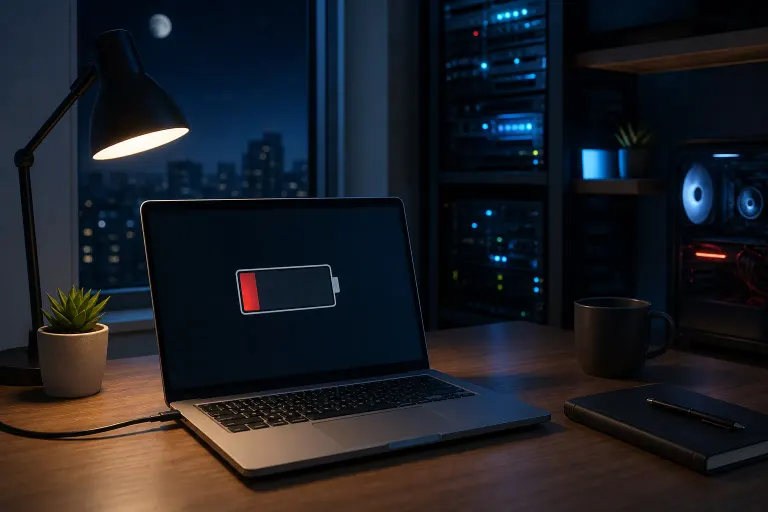
First things first. Charge the laptop to 100%, close the lid or put it to sleep, and check the battery percentage before bed and again in the morning. If it's dropping more than 5-10% overnight, something's waking it up. If it's dropping to zero in a couple of hours, that's a different problem entirely, and it usually points to a battery that's failing, not a software setting. We'll get to that.
On Windows, a normal sleep should sip maybe 1-2% per hour, tops. To put a number on that: an eight-hour overnight should cost you somewhere between 8% and 16% at the absolute worst, and most healthy laptops will land closer to 5-8%. On a MacBook, Apple's own sleep mode is supposed to be even more efficient than that. After the first hour or so in a deep sleep state, a MacBook in good shape might lose less than 1% per hour. So if you're waking up to a laptop that lost 40% overnight, it never really went to sleep. It was doing something.
One quick way to narrow things down before you dig into settings: feel the bottom of the laptop. If it's warm to the touch in the morning, the processor was running. A laptop that's genuinely asleep should be completely cool, or very close to it. Warmth means it was awake, and awake means it was burning battery.
Step 2: Check what's waking your Windows laptop up
Open Command Prompt as administrator and run this:
powercfg /lastwake
This tells you exactly what woke your laptop last. Sometimes it's a scheduled task, sometimes it's a network adapter, sometimes it's Windows Update deciding 2am is a great time to install things. A common output looks something like Wake Source: Device - Realtek PCIe GBE Family Controller, which tells you the network card pulled the machine out of sleep. That's fixable, and we'll cover it in a moment.
Next, run:
powercfg /devicequery wake_armed
This lists every device currently allowed to wake your laptop from sleep: network cards, keyboards, mice, even some USB hubs. A typical output might show four or five devices. Most of them are fine. The ones to watch are network adapters, especially anything labeled Wi-Fi or Ethernet, and occasionally Bluetooth controllers.
If you see your Wi-Fi adapter in that list, that's often your culprit. Disable wake permission for it in Device Manager: find the adapter under Network Adapters, right-click, go to Properties, click the Power Management tab, and uncheck "Allow this device to wake the computer." Do the same for your Ethernet adapter if it shows up. This alone fixes the overnight drain for a lot of people.
While you're in Command Prompt, run one more command:
powercfg /waketimers
Wake timers are scheduled tasks that are specifically allowed to pull the laptop out of sleep. Windows Update is a frequent offender here, but so are apps like Dropbox, antivirus software running scheduled scans, and even some video streaming apps that check for updates in the background. If you see a timer in the output, note the task name and look it up in Task Scheduler. You can disable the wake permission there without turning the task off entirely.
Computer acting up? Get a real diagnosis. Book a diagnostic
Step 3: Check what's waking your Mac up
On a Mac, open Terminal and run:
pmset -g log | grep -i wake
This pulls from the system's power management log and shows you every time the Mac woke up, along with a short reason. Common reasons you'll see include UserActivity (you or an app did something), RTC (a scheduled alarm), darkwake (background maintenance), and lidopen (you opened the lid). If you're seeing a long list of RTC or darkwake entries through the night, the Mac is waking itself up repeatedly to do background work.
MacOS has a feature called Power Nap that lets the machine wake briefly to check email, sync iCloud, and run backups while it looks asleep. On a plugged-in MacBook, this is mostly harmless. On battery, it quietly eats power all night. To turn it off, go to System Settings, search for Battery, and look for the Power Nap or "Enable Power Nap while on battery power" option and switch it off. On older macOS versions, this is under Energy Saver in System Preferences.
Also check for apps with login items that keep processes running in the background. Go to System Settings > General > Login Items and look for anything you don't recognize or don't need. Apps like Spotify, Creative Cloud, and even some VPN clients leave background agents running that can prevent the system from entering its deepest sleep state.
Step 4: Run a battery health check
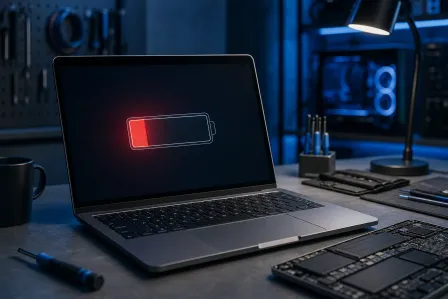
If you've killed the wake sources and it's still draining, the battery itself might be the problem. Batteries have a finite number of charge cycles, and once they start degrading, they lose capacity in ways that aren't always obvious. A battery at 60% of its original capacity might show "100%" at the top of the charge, but that 100% now represents a much smaller pool of actual energy. It'll drain faster and it'll feel like it's disappearing overnight even during light use.
On Windows, run this in Command Prompt as administrator:
powercfg /batteryreport
This generates an HTML report saved to your user folder, usually at C:\Users\YourName\battery-report.html. Open it in a browser and scroll to the section called "Installed Batteries." You're looking for two numbers: Design Capacity and Full Charge Capacity. Design Capacity is what the battery could hold when it was new. Full Charge Capacity is what it can hold now. If Full Charge Capacity is below 80% of Design Capacity, the battery is noticeably worn. Below 60%, you'll feel it every day, and replacement is worth the cost.
For example, a laptop with a Design Capacity of 56,000 mWh but a Full Charge Capacity of 31,000 mWh is running at about 55% of original capacity. That's not just overnight drain, that's a battery that'll struggle to get through a three-hour meeting.
On a Mac, hold Option and click the Apple menu, then click System Information. Go to Power in the sidebar. Look for Cycle Count and Condition. Apple considers most batteries healthy up to around 1,000 cycles. If the Condition says "Service Recommended" or "Replace Now," the battery has already been flagged by the system itself. Cycle counts above 800-900 on an older machine often come with noticeably reduced runtime even if the condition hasn't been flagged yet.
Step 5: Check your sleep mode settings
This one catches a lot of people. On Windows, there are actually several different sleep states, and not all of them are equal.
The most efficient is Hibernate, which writes everything in RAM to the hard drive and cuts power almost entirely. A hibernating laptop should lose essentially zero battery overnight. Modern Sleep (S3) keeps RAM powered so the machine wakes up instantly, but it does draw a small amount of power continuously. Connected Standby and Modern Standby, which are common on thin laptops and anything with a solid-state drive, keep the network active in the background, which sounds convenient but can quietly drain the battery if background sync apps are running.
To check which sleep state your laptop uses, run:
powercfg /a
This lists which sleep states are available on your hardware. If Hibernate is available but not configured, you can set the lid-close action to hibernate instead of sleep: go to Control Panel > Power Options > Choose what closing the lid does, and set it to Hibernate when on battery. You'll lose the instant-on wake-up, but overnight battery loss will drop to nearly zero.
Common mistakes that make this worse
Leaving the browser open with dozens of tabs. Some browsers, Chrome especially, keep background processes running even when the laptop is asleep if they're not fully closed. Closing the browser before you close the lid takes five seconds and can meaningfully reduce how much work the machine does overnight.
Skipping Windows Update restarts. When Windows has a pending update and you keep clicking "Remind me later," it will sometimes schedule itself to run during sleep. Restarting when prompted clears the queue and removes those wake timers.
Using a hub or dock that keeps USB devices powered. Some USB hubs will send a wake signal to the laptop if a device plugged into the hub has activity. Unplug the hub before bed, or check the hub's settings if it has software.
Assuming newer means better on battery. A three-year-old laptop with a healthy battery will often outperform a brand-new laptop with a cheaper battery or aggressive background sync features. Age isn't the only variable. Battery management software quality and background app behavior matter just as much.
When to stop troubleshooting and get it looked at
If you've checked the wake sources, confirmed the sleep state, disabled Power Nap, closed background apps, and the battery is still tanking overnight, it's time to stop guessing. A degraded battery that's showing internal resistance issues won't always flag itself clearly in a health report, and diagnosing it properly requires load testing with proper equipment. Bring it in and we'll pull a full diagnostic, check the battery under real load conditions, and tell you straight whether it's a replacement job or a settings issue we haven't found yet. Most battery replacements turn a frustrating laptop back into one that works the way it's supposed to.
Computer acting up? Get a real diagnosis.
Fix My PC Store has repaired thousands of machines across West Palm Beach. Honest pricing, no upsell games, and a free diagnostic for new customers with our email coupon.