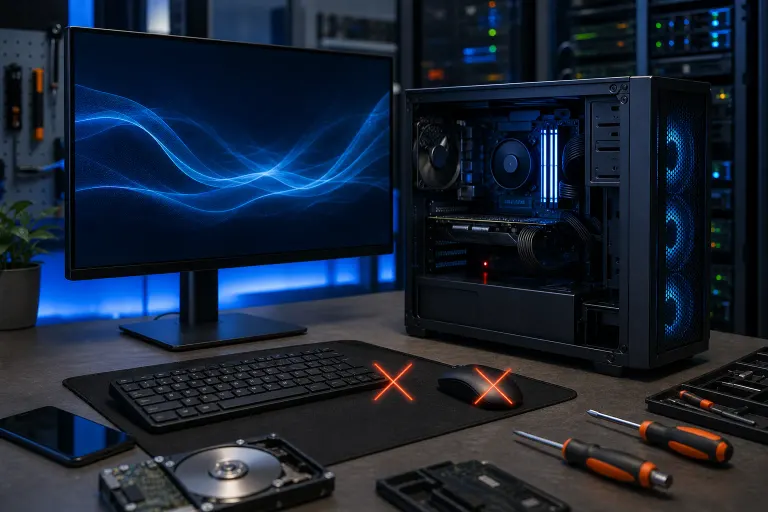
Computer Running but Mouse and Keyboard Won’t Work?
Your computer may be powered on, the screen may be lit, and programs may even be visible. But if the mouse and keyboard will not respond, you cannot do much with it. The good news is that this problem is often caused by a loose connection, a drained battery, a frozen system, or one troublesome USB device.
Start with the easy checks before assuming the computer needs a major repair. Work through the steps in order, and change only one thing at a time. That makes it much easier to identify what fixed it.
What you need
- A few minutes without needing to use the computer
- Access to the mouse and keyboard cables, USB receiver, or charging cable
- Fresh batteries if you use battery-powered wireless devices
- A second USB port, preferably on the back of a desktop PC
- If possible, a known-working wired USB mouse or keyboard
- Your computer’s power button
If you are using a laptop, remember that its built-in keyboard and trackpad are separate from any external mouse or keyboard. That distinction will help you narrow down the cause.
1. Check whether the computer is actually responsive
First, determine whether only the input devices have failed or whether the whole computer is frozen.
Look for signs of life. Does the clock change? Does a video continue playing? Does the Caps Lock light turn on and off when you press the key? On many keyboards, a changing Caps Lock or Num Lock light suggests the keyboard is still receiving power.
Try these quick checks:
- Move the mouse and watch for any cursor movement.
- Press
Caps LockorNum Lockand watch the keyboard indicator light. - Press
Ctrl+Alt+Deleteon Windows. If the security screen appears, Windows is still responding. - On a Mac, press
Command+Option+Escape. If the Force Quit window appears, macOS is responding. - If you have a laptop, try its built-in trackpad and keyboard.
If the display is frozen, the time never changes, and no key combination does anything, you may be dealing with a system freeze rather than a mouse or keyboard problem. Skip ahead to the restart step.
2. Inspect the physical connection
A surprising number of input problems come down to a cable or receiver that is not fully seated. This is especially common after moving a desktop, cleaning a desk, or plugging in several accessories.
For a wired mouse or keyboard, unplug it and reconnect it firmly. Do not just wiggle the plug. Remove it completely, wait a few seconds, then insert it again.
For a wireless mouse or keyboard, find the small USB receiver. It may be in a front USB port, behind the computer, or connected through a USB hub. Remove the receiver and plug it directly into a different USB port.
Avoid using a hub or monitor USB port while troubleshooting. Those devices can be convenient, but they add another possible point of failure.
Desktop owners should test a rear USB port if available. Rear ports connect more directly to the motherboard and can be more reliable than front-panel ports when a case cable or front port has an issue.
If you use a USB-C adapter or dock, temporarily bypass it. Connect a compatible device directly to the computer if you can.
3. Check power, batteries, and wireless pairing
Wireless devices can fail quietly. The computer may still be running perfectly while the keyboard batteries are dead or the mouse has lost its connection.
Turn the mouse over and check its power switch. Some models use a small switch that is easy to bump off. If there is a charging light, connect the device to power for a while before testing again.
For replaceable batteries, install fresh batteries instead of relying on old ones that “should still be good.” Check the battery orientation too. It sounds basic, but it is worth verifying.
If your keyboard or mouse connects by Bluetooth rather than a USB receiver, Bluetooth may have disconnected. If another input device still works, open the Bluetooth settings and confirm that the device is connected. You may need to remove it and pair it again using the manufacturer’s instructions.
On a laptop, airplane mode or a disabled wireless setting can sometimes interfere with Bluetooth devices. Use the built-in keyboard or trackpad if they still work to check those settings.
4. Try a different USB port and a known-good device
Now test the computer’s USB ports separately from the mouse or keyboard.
Move the mouse to another USB port. Then do the same with the keyboard. If both devices begin working in the new ports, the original port, hub, dock, or adapter is likely the problem.
If possible, test with a basic wired USB mouse or keyboard. You do not need a fancy model. A simple known-working device is useful because it eliminates batteries, wireless pairing, and special software from the equation.
Here is what the results usually mean:
- Your mouse works in another port: The first port or the hub may be faulty.
- A different mouse works, but yours does not: Your original mouse may have failed.
- A different keyboard works, but yours does not: Your keyboard may have failed.
- Nothing works in any USB port: The computer may be frozen, USB may be disabled, or there may be a deeper hardware or operating system issue.
- Only front USB ports fail on a desktop: The front panel connection inside the case may need attention.
Do not repeatedly force connectors into ports. USB plugs should insert with modest pressure and in the correct orientation.
5. Remove extra USB devices
Too many connected devices can occasionally cause a startup or USB recognition problem. This is more likely with docks, external drives, card readers, game controllers, webcams, printers, and charging cables all connected at once.
Shut the computer down if you can. Then disconnect nonessential USB accessories. Leave connected only:
- The monitor
- Power cable
- One wired keyboard, if available
- One wired mouse, if available
Start the computer again and test the basic devices. If they work, reconnect other devices one at a time. Test after each connection.
This step is particularly useful for a gaming setup with several peripherals and RGB controllers. A single malfunctioning device can interfere with a hub or cause confusing USB behavior. If your desktop has recurring peripheral or port problems, our computer repair team can test the ports, motherboard connections, and power behavior without guesswork.
Computer acting up? Get a real diagnosis. Book a free diagnostic
6. Restart the computer safely, then force a restart if needed
A normal restart clears many temporary driver and device communication problems.
If the keyboard still responds, use it to restart:
- Windows: Press
Ctrl+Alt+Delete, then useTaband arrow keys to reach the power icon and choose Restart. You can also pressAlt+F4from the desktop and select Restart. - Mac: Press
Control+Command+ the power button to restart. On some Mac keyboards, the Touch ID button is also the power button.
If neither the mouse nor keyboard responds and the computer is completely frozen, press and hold the physical power button for about 10 seconds until the machine turns off. Wait 15 to 30 seconds, then turn it back on.
A forced shutdown can cause unsaved work to be lost, so use it only when normal controls are unavailable. Once the computer starts again, test the keyboard and mouse before opening lots of programs.
If the issue returns right after startup, note whether it happens before or after you sign in. That detail helps separate a hardware problem from a user-profile, driver, or startup-software problem.
7. Check whether the devices work before Windows or macOS loads
This is one of the most useful troubleshooting steps. If a wired keyboard works in the computer’s startup menus but stops working only after Windows or macOS loads, the hardware is probably okay. The problem may be a driver, update, or software conflict.
On a Windows PC
Restart the computer and watch for the manufacturer logo. Try pressing F2, Delete, Esc, or F12 repeatedly to enter BIOS or UEFI setup. The correct key varies by computer.
If the keyboard works there, use the arrow keys to confirm it is responding. Exit without changing settings unless you know exactly what you are adjusting.
If the keyboard does not work even in BIOS or UEFI, try another wired keyboard and another USB port. Continued failure before Windows starts points more strongly toward a keyboard, USB port, motherboard, or power issue.
On a Mac
Mac startup options vary by model. On an Apple silicon Mac, shut it down, then press and hold the power button until startup options appear. On an Intel-based Mac, holding Option during startup can display startup choices.
If the built-in keyboard or trackpad is unresponsive even at startup, the problem may be hardware-related. A Mac that has been exposed to liquid, has a swollen battery, or has suffered an impact should be inspected promptly. Our Mac repair service can help with those hardware-level symptoms.
8. Fix drivers and updates after input returns
Once you have a working mouse or keyboard, check for software problems. Do this after basic hardware checks, not before. Drivers are not the most common cause of a completely dead wired keyboard and mouse, but they can matter after an update or a crash.
Windows steps
- Right-click the Start button and open Device Manager.
- Expand Keyboards and Mice and other pointing devices.
- Look for a yellow warning symbol or an unfamiliar device.
- Right-click the affected device and choose Uninstall device.
- Restart the PC. Windows should reinstall a standard driver automatically.
- Run Windows Update and install available updates, then restart again.
If the issue began immediately after a driver utility, peripheral software update, or Windows update, consider uninstalling the recently added peripheral software or using System Restore if you are comfortable with it.
For built-in laptop keyboards and trackpads, visit the laptop manufacturer’s support page and use the exact model number. Avoid random driver-download websites. They can install the wrong software or unwanted extras.
Mac steps
Install available macOS updates through System Settings when you can. Restart after the update finishes.
If an external Bluetooth device keeps disconnecting, remove it from Bluetooth settings and pair it again. For a wired USB device, test without docks, adapters, or hubs first.
If your laptop’s built-in keyboard, trackpad, or charging behavior is inconsistent, it may be time for professional laptop repair, especially if the issue followed a spill, drop, heat exposure, or battery swelling.
9. Check accessibility settings that can make input seem broken
Sometimes the keyboard and mouse are working, but a setting has changed how they behave.
On Windows, check Settings > Accessibility > Keyboard. Features such as Filter Keys can change how long you must hold a key before Windows recognizes it. Mouse Keys can also make the numeric keypad control the pointer, which can be confusing if enabled accidentally.
On a Mac, check System Settings > Accessibility > Keyboard and Pointer Control. Slow Keys, Mouse Keys, and similar options can alter normal input behavior.
These settings usually do not make every device completely dead. Still, they are worth checking if keys seem delayed, repeated, ignored, or oddly mapped.
10. Know when it is time for hands-on help
Stop troubleshooting and get help when you see signs of a hardware problem:
- The keyboard and mouse fail in every port, including during startup.
- USB ports are loose, damaged, hot, or visibly bent.
- The computer was exposed to liquid, smoke, a power surge, or a recent drop.
- The laptop keyboard or trackpad is bulging, lifting, or behaving erratically.
- The issue keeps returning after restarts and updates.
- You need files from the computer and are worried about making things worse.
For a work computer, avoid installing random “driver fixer” tools or making broad system changes. A repeated input failure can interrupt access to files, cloud apps, and business systems. South Florida businesses can get ongoing monitoring and practical help through managed IT services, including support for recurring workstation issues.
If you are in West Palm Beach, Palm Beach County, or the Treasure Coast and want a technician to diagnose the cause, you can contact Fix My PC Store. Bring the mouse, keyboard, receiver, dock, and power adapter with the computer when possible. Those accessories can be part of the problem.
Common mistakes
- Replacing the mouse before testing another port. A bad port, hub, or receiver connection can look exactly like a bad mouse.
- Testing both devices through the same hub. If the hub is the issue, both tests will fail and give you misleading results.
- Forcing a shutdown right away. First check whether
Ctrl+Alt+DeleteorCommand+Option+Escapeworks. You may be able to restart normally and save some work. - Changing many settings at once. Restarting, updating drivers, changing ports, and pairing Bluetooth devices all at once makes it hard to know what helped.
- Using untrusted driver download sites. Get updates through Windows Update, macOS, or the computer manufacturer’s official support page.
- Ignoring liquid or battery symptoms. Sticky keys, a lifting trackpad, corrosion, or a swollen case are not normal software problems. Power the device down and have it checked.
- Assuming a wireless device is charged because its light comes on. A light can indicate partial power. Fully charge it or use fresh batteries before ruling that out.
Bottom line
When a computer is running but the mouse and keyboard will not work, begin with connections, batteries, ports, and a restart. Then test a known-good wired device and see whether input works before the operating system loads. Those checks quickly tell you whether the likely cause is the accessory, USB connection, wireless pairing, software, or computer hardware.
Take it one step at a time. Most cases become much less mysterious once you isolate the one part that is not responding. And if all input devices fail across multiple ports, or the computer shows signs of physical damage, a professional diagnosis is the safer next move.
Computer acting up? Get a real diagnosis.
Fix My PC Store has repaired thousands of machines across West Palm Beach. Free diagnostics, honest pricing, no upsell games.