Laptop Screen Black on One Side? Here's What's Wrong
TL;DR
A laptop screen that's black on one side while the other half still shows an image is almost always a hardware problem, not software. Nine times out of ten it's a busted display cable, a cracked panel, or a dying backlight strip. Grab an external monitor, run one quick test, and you'll know in five minutes whether this is a cheap fix or a full screen swap.
What you need
- An external monitor or TV with an HDMI cable (or USB-C if your laptop supports DisplayPort out)
- A flashlight
- A soft cloth and good lighting
- 10-15 minutes
- Optionally, a small Torx or Phillips screwdriver set if you're comfortable popping the bezel
You do not need any special software for this. This is a physical diagnosis, not a driver issue, so don't waste time reinstalling graphics drivers before you rule out hardware.
Computer acting up? Get a real diagnosis. Book a free diagnostic
Step 1: Confirm it's not a graphics card or driver glitch
Before you assume the worst, plug your laptop into an external monitor or TV. Hit the display key combo (usually Fn + F4, F5, or F8 depending on your brand) to project the image externally.
If the external display shows a full, clean picture with no dark zones, your GPU and motherboard are fine. That confirms the problem lives inside the laptop screen assembly itself, either the panel, the cable, or the backlight. If the external monitor ALSO shows a half-black image, stop here, that points to a GPU or motherboard issue, which is a different repair entirely and worth a proper diagnostic at a computer repair shop.
Assuming the external display looks perfect, move on.
Step 2: Shine a flashlight at the dark half
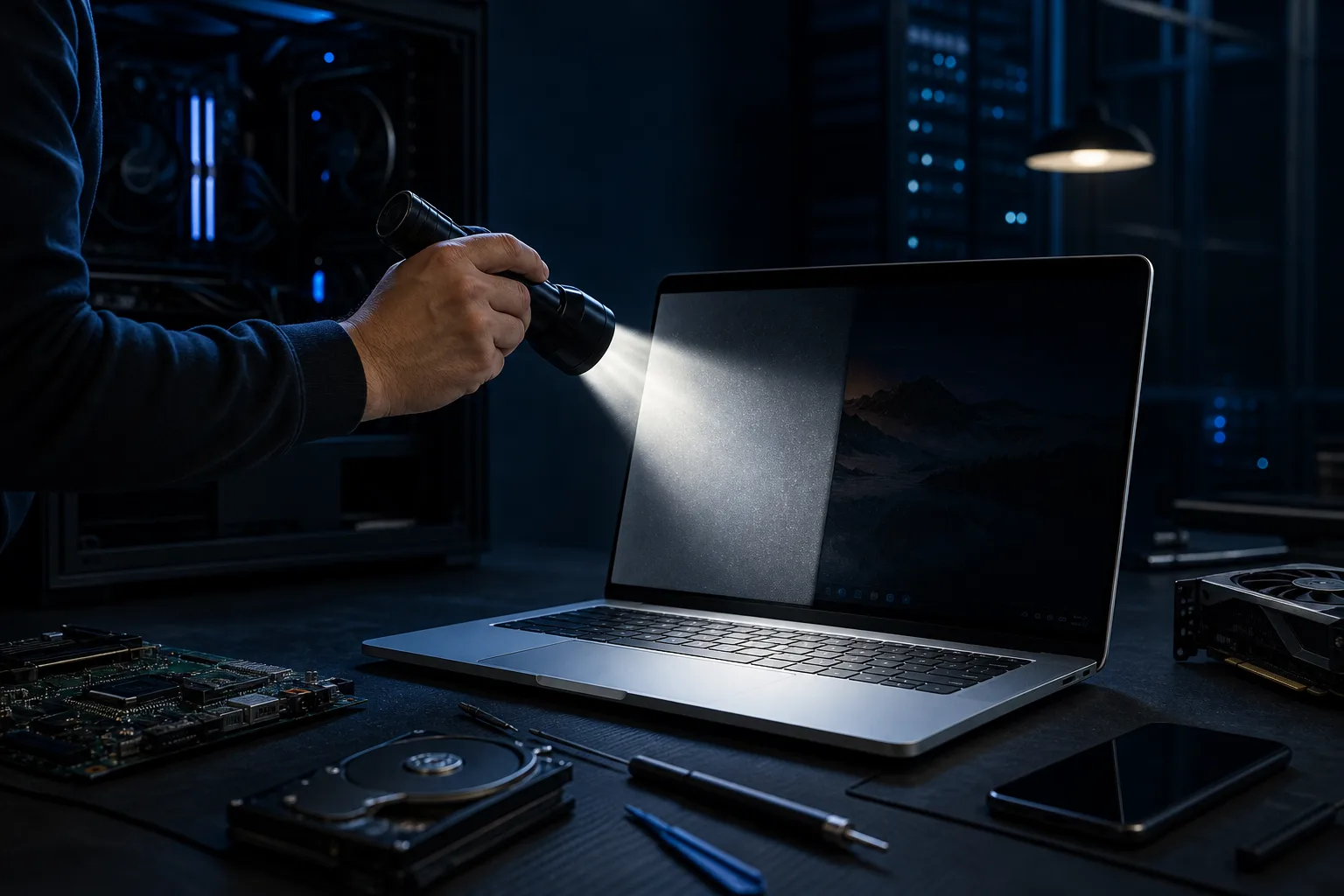
This is the single best DIY test for laptop screens. Turn the laptop on, aim a flashlight directly at the black section of the screen, and look closely.
If you can faintly make out windows, icons, or a desktop image ghosting through the darkness, your backlight is failing on that side. The image is technically still there, it's just not illuminated. That's usually a backlight inverter or LED strip problem, common on older laptops with CCFL backlights and still possible on LED panels when the strip along one edge dies.
If you see absolutely nothing, no ghost image at all, the panel itself is likely damaged or not receiving signal to that half. That points toward a cracked panel or a display cable issue instead.
Step 3: Check for physical damage and flex points
Inspect the lid closely, especially the top corners, hinges, and the bezel edges. A black section that lines up with a corner of the screen often means impact damage cracked the LCD panel internally, even if the glass on top looks intact.
Now gently flex the lid open and closed by a few degrees while the screen is on (don't force it). Watch the black area as you move it. If the dead zone flickers, shifts, or briefly comes back to life when you flex the hinge, that's a strong sign the display cable is pinched, frayed, or partially disconnected where it routes through the hinge. This is one of the most common causes of a
Computer acting up? Get a real diagnosis.
Fix My PC Store has repaired thousands of machines across West Palm Beach. Free diagnostics, honest pricing, no upsell games.