Laptop Won’t Charge? Step-by-Step Fixes Before You Replace It
Listen to this article
TL;DR: If your laptop won’t charge, don’t rage-buy a new battery yet. We’re going to run a clean, safety-first checklist to figure out if the culprit is the outlet/adapter, USB-C Power Delivery mismatch, a damaged DC jack, Windows power reporting, battery wear, or a motherboard charging circuit issue.
By the end, you’ll have a clutch diagnosis and a clear decision point: what you can safely test at home, and when it’s time to tag in a pro for laptop power diagnostics in Palm Beach County.
Laptop won’t charge: Safety rules before we start
Alright gamer, before we go full detective mode, we keep it safe. Electricity is not a “gg ez” situation.
Quick safety checklist
- Unplug first before inspecting ports, cables, or the laptop underside.
- Stop if you smell burning, see melting plastic, or the charger gets dangerously hot. That’s a hard stop.
- Don’t use random chargers that “kinda fit.” Wrong voltage or a sketchy adapter can cook a charging circuit.
- If the laptop has a swollen battery (bulging case, trackpad lifting), do not press on it or keep charging it.
If any of the above is happening, skip the DIY and go straight to professional laptop repair to avoid turning a simple fix into a motherboard tragedy.
AC adapter troubleshooting: Is it the wall, the brick, or the cable?
This is the most common W in the troubleshooting game. Power issues often start outside the laptop. We’re going to isolate the chain: wall outlet - power strip - AC adapter - cable - laptop.
Step 1: Test the outlet and power strip
- Plug a phone charger or lamp into the same outlet. No power? The outlet or breaker is the issue.
- If you’re using a surge protector, try a different outlet without the strip. Power strips fail more than people think.
Step 2: Check the adapter LED and cable wear
Many laptop chargers have a little LED on the brick. If it’s off, flickering, or only comes on when you bend the cable, that’s a dead giveaway.
- Inspect for frays near the brick and near the laptop connector.
- Feel for loose barrel tips or cracked housings.
- If the adapter “buzzes” or gets super hot fast, retire it.
Step 3: Confirm the charger is the right wattage
Chargers are like GPUs: the label matters. A 45W adapter trying to feed a laptop that expects 65W or 90W can cause slow charging, no charging under load, or the classic “plugged in, not charging” vibe.
- Look at the charger label for W (watts) or V and A (volts and amps).
- Match it to your laptop’s requirements (usually printed on the bottom of the laptop or in the manual).
If you’re not sure, bring the laptop and charger in. Our bench can verify what’s happening without guesswork via computer repair diagnostics.
USB-C laptop not charging: Power Delivery and port rules (this matters)
USB-C is awesome… when it’s done right. But “USB-C shaped” does not automatically mean “charges the laptop.” This is where a lot of people get baited into buying three chargers and still get zero juice.
Step 1: Confirm the USB-C port supports charging
Some laptops have multiple USB-C ports, and only one supports charging (often marked with a lightning bolt icon or a battery/plug symbol). Try the other port if available.
Step 2: Check USB-C Power Delivery (USB-C PD) wattage
For a usb-c laptop not charging situation, the most common issue is PD wattage and profiles. Many laptops want 65W, some want 90W or more, and gaming laptops can require even higher through their proprietary barrel adapter.
- Phone chargers (18W-30W) usually won’t cut it.
- Docking stations may provide limited power (like 60W) and your laptop may drain while “plugged in” during gaming.
- Use a known-good USB-C PD charger that meets or exceeds the laptop’s requirement.
Step 3: Try a different USB-C cable (yes, the cable can be the villain)
Not all USB-C cables are created equal. Some are charge-only, some are data-only, and some can’t carry higher wattage reliably. A high-wattage PD-rated cable can be the difference between “it runs” and “it FLIES.”
Charger vs battery diagnosis: What the symptoms are really telling you
Now we read the signs like benchmark charts. Here’s the quick decode:
Symptom map
- Charging light never turns on: outlet/adapter/port/motherboard power path issue.
- Charging light flickers when you move the plug: likely laptop charging port repair territory (loose DC jack) or a broken cable.
- Laptop shuts off when unplugged: battery is not holding charge, not connected internally, or battery circuitry is failing.
- Charges while off, not while on: adapter wattage too low, overheating, or system load too high.
- “Plugged in, not charging” in Windows: could be battery health, OEM charge thresholds, driver/firmware reporting, or adapter mismatch.
Battery not charging Windows: Fixes in Windows 10 and Windows 11
If the hardware checks out but Windows is acting sus, we do software sanity checks. This won’t magically repair a dead battery, but it can fix bad reporting, stuck drivers, or power settings that make it look worse than it is.
Step 1: Power cycle reset (fast and underrated)
- Shut down the laptop.
- Unplug the charger.
- If the battery is removable, remove it. If not, skip this step.
- Hold the power button for 15-20 seconds.
- Reconnect power (and battery if removed) and boot.
This clears some embedded controller weirdness that can cause charging detection issues.
Step 2: Check Windows battery and power guidance
Microsoft maintains general battery and power troubleshooting steps here: Microsoft Support for Windows battery and power troubleshooting. It’s a solid reference for settings and basic diagnostics.
Step 3: Device Manager battery driver refresh
In Device Manager under Batteries, you’ll typically see items like “Microsoft AC Adapter” and “Microsoft ACPI-Compliant Control Method Battery.” You can uninstall the battery device (not the adapter), reboot, and Windows will reinstall it. If you’re not comfortable, no shame. We do this daily as part of laptop repair service.
Step 4: OEM charge limits (not a bug, a feature)
Some manufacturers include battery health modes that cap charging to around 80%-85% to reduce wear. That’s actually a smart long-term play. If you see it stuck at a specific percentage, check your OEM utility or BIOS/UEFI settings for “Battery Health,” “Conservation Mode,” or similar.
Laptop charging port repair: How to spot a bad DC jack (without breaking it more)
Let’s talk ports. The DC jack (barrel charging port) and USB-C port take physical abuse every day. One bad yank and suddenly your “charging” becomes “charging if I hold it at a 17-degree angle.”
Signs your charging port is damaged
- Plug feels loose or wobbly
- Charging cuts in and out with gentle movement
- Visible bent pin (barrel jack) or damaged tongue (USB-C)
- Port feels hot during charging
Safe at-home test: the gentle wiggle check
With the laptop on a stable surface, plug in power and very gently apply tiny movement to the connector. If the charge light flickers, that’s a strong indicator of port wear or cracked solder joints.
Important: Don’t keep doing this repeatedly. If the port is failing, extra movement can rip pads off the motherboard. That turns a straightforward fix into a bigger repair.
DC jack replacement: When it’s DIY-able vs when it’s pro-only
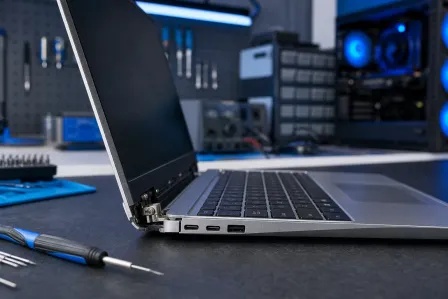
Some laptops use a DC jack on a separate cable harness (easier), others have the jack soldered directly to the motherboard (harder). USB-C charging ports are also commonly board-soldered and can require micro-soldering.
DIY-friendly scenarios
- DC jack is a replaceable harness (plug-in connector)
- You can access it without removing the entire motherboard
- No signs of burning, corrosion, or liquid damage
Pro-only scenarios (recommended)
- Soldered DC jack or USB-C port replacement
- Port area looks charred or smells burnt
- Charging works intermittently and you suspect motherboard damage
If you’re in West Palm Beach or anywhere in Palm Beach County, this is exactly the kind of repair we handle with proper tools and inspection at Fix My PC Store. Start with computer repair diagnostics and we’ll tell you if it’s a simple port job or something deeper.
Laptop shuts off when unplugged: Battery health and wear checks
This symptom is basically the laptop screaming: “My battery is not contributing!” That can be normal aging, a failed battery pack, or a connection issue internally.
What battery wear looks like in real life
- Battery percentage drops fast (like falling FPS in a poorly optimized game)
- Laptop only runs on AC power
- Battery won’t charge past a low percentage or won’t charge at all
Battery replacement: smart move, but only after charger/port checks
Replacing the battery can be a banger upgrade for productivity laptops, but don’t buy parts blind. If the real issue is the charger or DC jack, a new battery won’t fix it. Worse, you might introduce a low-quality third-party battery into a system with an existing charging fault.
Laptop power diagnostics: When it’s the motherboard charging circuit
Okay, here’s the final boss. If you’ve verified the outlet, tested a known-good charger, confirmed USB-C PD compatibility (if applicable), and the port still isn’t stable, the issue can be inside the laptop: charging ICs, MOSFETs, fuses, or power-path components on the motherboard.
Common signs of motherboard-level charging failure
- No charge on multiple known-good chargers
- Battery is known-good but still won’t charge
- Port is physically fine, but charging is dead
- Liquid damage history or corrosion near power circuitry
Why professional diagnostics saves money
This is where people accidentally spend more than the repair by buying “maybe it’s this” parts. A proper diagnostic bench can test adapter output, battery behavior, and board-level charging rails. If the motherboard repair isn’t cost-effective, you’ll know before throwing cash at it.
And hey, if the laptop is failing in multiple ways (random shutdowns, pop-ups, weird performance), it’s worth checking for malware too. Some infections can cause high CPU usage and heat, which can make charging look inconsistent. If that’s a concern, our virus removal service can clean it up. You can also learn more from Malwarebytes resources.
Palm Beach County laptop repair: When to stop troubleshooting and bring it in
DIY is awesome. I love a good at-home fix like I love a clean RGB cable run. But here are the decision points where you should stop and get help:
- You see sparking, melting, smoke, or smell burning
- The charging port is loose or cracked (risk of motherboard damage increases fast)
- The laptop only works on AC and shuts off instantly when unplugged
- You tried a known-good charger and it still won’t charge
- USB-C charging is inconsistent and you’re unsure about PD wattage compatibility
Fix My PC Store supports West Palm Beach and the wider Palm Beach County area (including nearby cities and neighborhoods). If your laptop won’t charge, we’ll diagnose it cleanly and recommend the most cost-effective fix, whether that’s a charger replacement, DC jack replacement, battery replacement, or board-level repair. And if your system is at risk, we can also help protect your files with data recovery services before anything gets worse.
Quick checklist: What to test at home (in order)
- Different outlet (skip the power strip)
- Inspect charger and cable for damage
- Verify correct charger wattage
- USB-C PD charger + PD-rated cable (if USB-C charging)
- Try the other USB-C port (if available)
- Power cycle reset
- Windows driver refresh (Device Manager battery)
- Gentle port stability check (no aggressive wiggling)
If you’re still stuck after that list, that’s not an L. That’s just the point where proper tools and diagnostics become the fastest path to a win.
Need Expert Computer Support?
Get professional help from Palm Beach County's trusted computer repair specialists.
Get Help Today