Laptop Won't Turn On: Step-by-Step Troubleshooting Guide
TL;DR: A laptop that appears dead can have several causes: power, display, battery, startup software, or internal hardware. Start with safe external checks. Stop immediately if the battery is swollen, the charger is damaged, or the device is hot or smells unusual. Model-specific service steps belong in the manufacturer's manual or with a technician.
What You Need
- The original or a manufacturer-approved compatible charger and cable
- A working outlet and, if available, a compatible external monitor
- Your laptop model number so you can read its official user guide
- A phone to photograph error messages or indicator-light patterns
You do not need a paperclip or screwdriver for the first checks. Do not insert a tool into an unidentified hole or open the case just because a general article suggests it. The location and procedure vary by model.
Step 1: Check the External Power Path
First check for heat, smoke, odor, a swollen case, or visible damage to the charger or cable. If any are present, stop using and charging the device and seek qualified service. A swollen battery needs prompt attention; HP advises discontinuing laptop use until replacement.
Otherwise, try a known-working outlet without an extension strip. Seat the charger at the wall and computer, without forcing or wiggling a loose connector. A charging light can help, but not every adapter has one; the absence of an LED does not prove charger failure. If your model charges by USB-C, check the manufacturer’s manual to confirm the port supports charging and the adapter meets its requirements. Dell notes that compatibility involves the connector, power capability, and model-specific identification.
If you have a known-compatible spare charger, try it. If the connector feels loose, stops charging when touched, or appears damaged, stop and have the port assessed. A light that remains off after a short charge does not identify the failed part on its own.
Step 2: Try a Model-Appropriate Power Reset
If the laptop shows no physical damage and the charger is compatible, disconnect external devices such as docks, USB drives, and printers. Unplug power. If your battery is designed to be removed by the user, remove it according to the manual. Some manufacturers recommend holding the power button briefly to reset a stuck power state; the exact duration varies. Lenovo’s IdeaPad guidance, for example, gives different steps for removable and internal batteries.
If the laptop has an emergency reset hole, use it only after the official manual confirms its location and procedure for your exact model. Never use a paperclip on an unidentified opening. Reconnect power and test once. A reset is a diagnostic step, not evidence that capacitors caused the fault and not a guaranteed repair.
Step 3: Check the Display, Not Just the Power
Some laptops are actually running but showing a completely black screen. The machine is on, the fan might spin briefly, but you think it's dead because you see nothing.
Try this: Hold the power button, let the machine attempt to boot, then shine a flashlight at a sharp angle across the screen. Sometimes the backlight is dead but the display is technically showing an image. You'll see a faint ghost of the desktop or a cursor.
Also try connecting an external monitor via HDMI or DisplayPort if you have one handy. If an external display works, the built-in display path becomes a stronger suspect, but it does not identify one failed component. Modern laptops may not use a separate backlight inverter.
Press the function key that switches display output (often Fn + F4, Fn + F7, or Fn + F8 depending on the brand) while connected to external display.
Step 4: Listen and Look for POST Activity
POST stands for Power-On Self Test. It's what your laptop does in the first second or two after you press power. It checks memory, storage, and basic hardware.
Press the power button and pay close attention:
- Do any LEDs flash at all, even briefly?
- Does the fan spin up for a moment then stop?
- Do you hear any beeping? (Beep codes vary by model; look up the pattern in the manufacturer’s guide.)
- Do you hear a click from the hard drive area? (Repeated clicking from a mechanical drive can indicate a fault. Note the sound and avoid repeated power cycles if important data lacks a backup.)
No lights or fan activity can point toward the power path, but does not identify the failed component.
Activity that stops can have several causes. Record any indicator or beep pattern and check the manufacturer’s model-specific diagnostic guide before drawing a conclusion.
Computer acting up? Get a real diagnosis. Request an evaluation
Step 5: Consider the Battery Only If User-Removable
For a laptop with a battery explicitly designed for user removal, follow the manufacturer’s instructions to remove it and try the correct AC adapter. Dell includes this test in its no-power workflow. Do not open a laptop to disconnect an internal battery unless its service documentation permits that work and you are trained to do it. A swollen battery must not be handled or charged as a routine troubleshooting step.
If a user-removable battery is out and the laptop starts on AC, the battery or its charging path may be involved; this result alone does not prove which component failed. Ask about a safe replacement and back up important files if the system becomes accessible. If the machine still does not start, continue with external checks or service rather than repeatedly opening it.
For business files, plan recovery around a verified backup. A no-power symptom does not tell you whether the storage is healthy or whether data can be recovered.
Step 6: Leave Internal Memory Checks to the Model Guide or a Technician
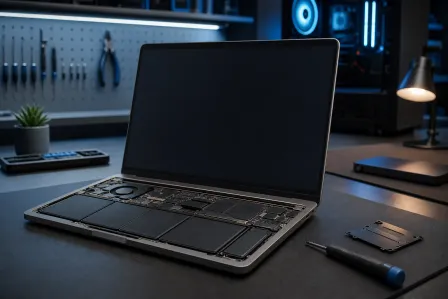
Some laptops have replaceable RAM; others have soldered memory. A no-power or no-display symptom alone does not identify loose RAM. Opening a thin laptop may expose an internal battery and delicate connectors, and the procedure varies widely. If the official service manual for your exact model documents user-accessible RAM and you have the necessary experience, follow that procedure. Otherwise, note the symptoms and let a qualified technician test memory and other components.
If the laptop was recently dropped, exposed to liquid, or repaired, mention that history. It gives the technician better evidence than repeatedly removing parts. Do not turn on a liquid-damaged device merely to test its RAM or display.
Step 7: Rule Out a Failed Operating System vs. Failed Hardware
If the laptop has power but shows a blinking cursor or error, the cause may involve boot settings, the storage device, or operating-system files. Microsoft's blank-screen guide distinguishes several patterns; this symptom does not clear all hardware.
If your files are backed up and you are comfortable with recovery tools, you can use official Windows recovery media following Microsoft's instructions. Do not select an install or erase option while diagnosing a device that contains unbacked-up files.
If you can boot trusted recovery media but not the installed system, the internal boot path needs diagnosis; the cause may be storage, firmware settings, or operating-system files. If the drive makes repeated clicking sounds or important files lack a backup, minimize further attempts and discuss recovery before reinstalling.
If recovery media also fails, that alone does not prove a hardware failure; the media, boot settings, or model's security configuration may be involved. Seek a model-specific diagnosis.
Common Mistakes
Buying a new charger that's the wrong wattage. Voltage and amperage matter. A charger that's too weak won't power the machine under load. Higher wattage alone is not the problem when the charger is otherwise approved and compatible. Match the connector, voltage or USB-C Power Delivery support, and manufacturer guidance before buying a replacement.
Assuming a black screen means the laptop is dead. As covered in Step 3, power and display symptoms can look similar. If it is safe and your model supports it, an external display is one useful check.
Repeatedly pressing the power button. If the machine does not respond after a normal attempt, record the symptoms and consult the manual before a model-specific reset. Repeated attempts can complicate diagnosis, particularly if a drive is making unusual noises.
Trusting random YouTube fixes for beep codes without knowing your exact model. Beep codes are not universal. Three beeps on an HP means something completely different than three beeps on a Dell. Look up your specific model.
Ignoring a swollen battery. If you remove the bottom panel and see a battery that looks puffed up or warped, stop using the laptop immediately. A swollen lithium battery is a fire hazard. This is not a "deal with it later" situation. Contact us or any qualified repair shop right away.
Skipping the model-specific power reset without checking the manual. Use the model-appropriate reset only after checking for battery, charger, and other physical safety concerns.
Bottom Line
A laptop that appears dead may have a simple external power issue or a fault that requires internal diagnosis. The safe checks above can narrow the possibilities, but they do not identify every cause. Record what worked and what did not before requesting service.
If you've gone through all of this and the machine still won't respond, or if you found a clicking drive, a swollen battery, or no activity at all, it's time for a professional look. We're in West Palm Beach and we work on PCs and Macs from all over Palm Beach County and the Treasure Coast. You can schedule a repair online or just bring it in.
If you'd rather not drag the machine anywhere, we also offer remote support for appropriate software questions once the device can connect safely. A no-power laptop or suspected failing drive needs an in-person assessment.
Do not discard the machine before a technician has assessed repair and data-recovery options.
Computer acting up? Get a real diagnosis.
Fix My PC Store offers an initial evaluation and written estimate for most standard in-store repairs. Fees for advanced diagnostics or data recovery are disclosed before chargeable work.