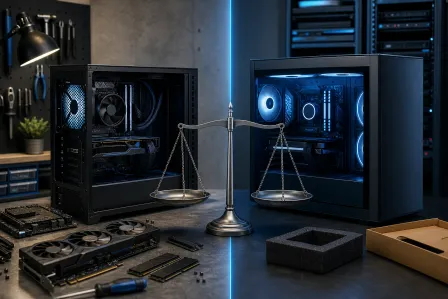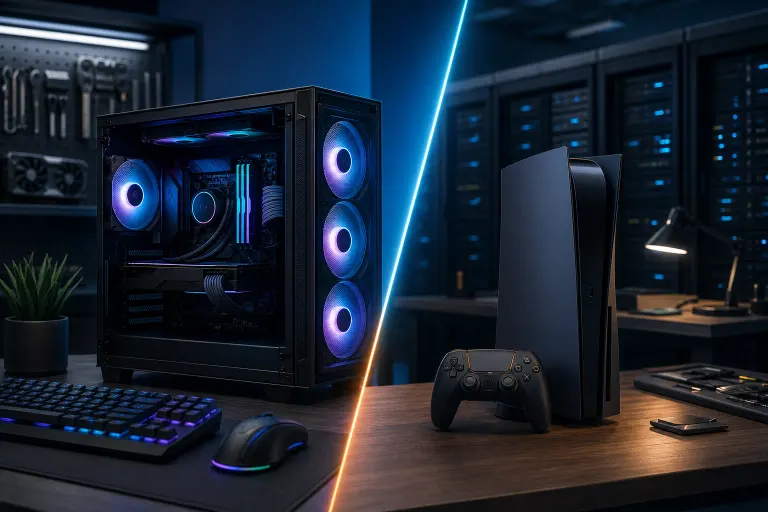
Gaming PC vs. Prebuilt Console: Which Gets You More?
TL;DR: Consoles are cheaper upfront and dead simple to set up. A gaming PC costs more to start but pays off hard in raw performance, game prices, upgrade flexibility, and everything else you can do with the machine. If you're serious about frames and future-proofing, the PC wins. Period.
At a Glance: Console vs. Gaming PC
| Factor | Prebuilt Console | Gaming PC |
|---|---|---|
| Upfront cost | Lower | Higher |
| Game prices over time | Higher (less sales) | Much lower (Steam, etc.) |
| Performance ceiling | Fixed at launch | Upgradeable |
| Resolution / frame rate | Limited by hardware | Scales with budget |
| Backward compatibility | Varies by platform | Near-universal |
| Multitasking / work use | Minimal | Full OS, unlimited apps |
| Repairability | Difficult, often voided | Mostly straightforward |
| Online multiplayer fees | Yes (subscription) | Usually free |
Let's dig into each of these properly.
Upfront Cost: Consoles Win the Sprint
No argument here. A current-gen console runs somewhere in the $400-$500 range. You plug it in, you play. Done.
A capable gaming PC that competes with those consoles is going to run you more. Entry-level builds that hit 1080p at solid frame rates start around $700-$900 when you factor in the operating system and peripherals. A true 1440p or 4K rig costs more.
But here's the thing: upfront cost is only one number in the equation.
Long-Term Game Costs: PC Destroys the Console
This is where the console's cheap entry price quietly evaporates. PlayStation Plus and Xbox Game Pass (at the higher tiers) cost real money every year just to play online. That's a recurring tax on top of already pricey game launches.
PC gaming flips the script. Steam sales, Humble Bundle, Epic's free weekly games, GOG, and key resellers mean you can build a massive library for a fraction of what console gamers pay. If you're a big buyer, the savings over two or three years can offset a chunk of that higher PC build cost.
You also own your games outright. No subscription lapses and your library disappears.
Raw Performance: Frames Don't Lie
Okay, THIS is what I get hyped about. Consoles are fixed hardware. Whatever frames-per-second and resolution the manufacturer targeted at launch is roughly what you're getting for the next seven years. Developers push optimizations over time, sure, but the ceiling is the ceiling.
A gaming PC has no ceiling. A mid-range build today at 1080p 144Hz absolutely smashes console frame rates on most titles. Bump the budget and you're at 1440p 165Hz or 4K with ray tracing doing things that current consoles simply cannot do.
Want to see what a properly spec'd build looks like? Check out some of our custom gaming PC builds to get a real sense of what different budgets actually deliver in performance.
Monitor refresh rate matters too. Most people run console gaming on a TV at 60Hz. Once you've played a competitive shooter at 144Hz on a PC monitor, going back feels like running through wet concrete. That's not hype. That's physics.
Upgradeability: The PC's Superpower
A console is a sealed box. When it gets old and slow, you buy the next console. Full stop.
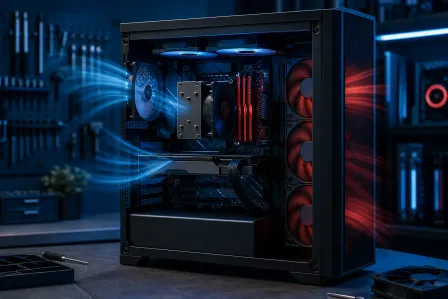
A gaming PC is modular. Your case, power supply, and storage might survive three or four GPU generations. Slot in a new graphics card in two years and your PC gets a massive performance jump without replacing everything. Add more RAM when prices drop. Upgrade to an NVMe SSD. The platform evolves with you.
This is the single biggest reason a higher upfront PC investment makes mathematical sense over a five-to-seven year window. You're not throwing the whole machine away. You're swapping the parts that matter.
If a component does fail or you want to push the build further with overclocking, our team has handled everything from busted GPU slots to full custom loop cooling setups. You can always reach out to book a consult if you want expert eyes on a build.
Ready to build a rig that actually rips? Start your build
Versatility: The PC Does Everything Else Too
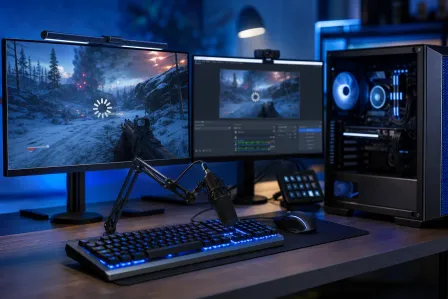
Your PlayStation does not do your taxes. Your Xbox won't run Adobe Premiere, your Discord overlay, a second monitor, or a stream setup without a separate PC anyway.
A gaming PC is a full computer. Work, school, content creation, video editing, streaming, browsing, anything. The hardware you buy for gaming is the same hardware running your whole digital life. That's real value that a console cannot touch.
For anyone in South Florida working from home or running a small business, this matters even more. The machine you game on at night can be the machine you use for productivity during the day. If you ever want to talk through remote support options or making sure your gaming rig is also work-safe and secure, our remote support team can help you sort that out.
Repairability and Longevity
Consoles are notoriously annoying to repair. Manufacturers have gotten slightly better, but opening one up often voids warranties and parts availability for older models is rough. A thermal paste replacement on a PlayStation that's throttling from heat? More complicated than it should be.
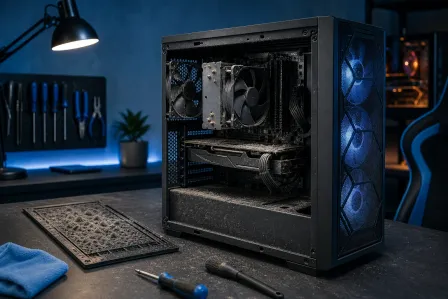
PC components are standardized. A bad power supply, a failing drive, a GPU with a fan issue: these are all fixable without scrapping the whole machine. We do this every week at Fix My PC Store for local West Palm Beach and South Florida customers. Bring it in, we diagnose it, we fix the part that's broken. The rest of your build stays intact.
If your gaming rig is throwing errors or underperforming, our computer repair service is built exactly for situations like that.
What About Prebuilt Gaming PCs? (The Middle Ground)
Wait, what if you want PC gaming without building it yourself? That's a legitimate option. Prebuilt gaming PCs from brands like CyberPowerPC, NZXT, and iBUYPOWER sit between a console and a custom build in terms of effort. You get PC flexibility without the assembly.
The tradeoffs: prebuilts often use lower-quality power supplies and cases to hit a price point, and they come loaded with bloatware. They're a valid starting point, but if you want something actually spec'd right for your budget, a custom build almost always gives you more per dollar.
We've got a gaming PC builder tool that helps you spec a custom build based on what you actually want to play and how much you want to spend. Worth checking before you drop money on a prebuilt from a big box store.
We've also done some wild custom builds worth a look if you want inspiration. The Times Square gaming PC build is one of our favorites, and the RGB monster Ryzen 9 9950X build shows what a top-tier rig actually looks like.
Console Makes Sense If...
Let's be honest. Consoles aren't wrong for everyone.
- You share the TV with the family and want couch co-op gaming.
- You play a handful of exclusives and nothing else.
- You have zero interest in tweaking settings or hardware.
- You want the absolute lowest barrier to just picking up and playing.
- You're buying for a younger kid who doesn't need a full computer.
For those scenarios, a console is a reasonable, simple choice. No shame in it.
PC Makes Sense If...
- You care about frame rates and visual quality.
- You play online competitively.
- You want a machine that also does real work.
- You game across multiple genres with a big, affordable library.
- You plan to keep the machine for more than three years.
- You want the option to upgrade instead of replace.
If more than two or three of those describe you, a PC is your answer.
Verdict: PC Wins on Value, Console Wins on Simplicity
Short version: if money is extremely tight right now and you just want to play games, a console gets you there faster. No argument.
But if you're thinking even slightly long-term, a gaming PC is the smarter investment. Lower game costs, better performance, full upgradeability, and a machine that does literally everything else. The higher upfront number looks a lot smaller when you spread it across five years of actual use.
For South Florida gamers who want to build something right the first time, or upgrade what they already have, we're here for it. Use the custom gaming PC wizard to start speccing your build, or contact us directly to talk through options with someone who actually knows their hardware.
Let's get you more frames.
Ready to build a rig that actually rips?
Custom gaming PCs built and tuned by people who game. Tell us your budget and target frame rate.